

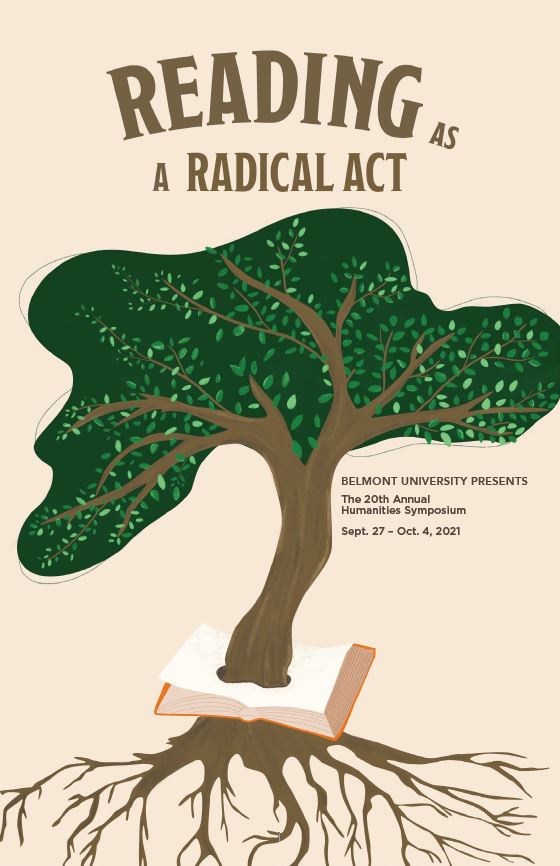
2021 - Reading As A Radical Act
Featured Speakers
Jeanne Canella Schmitzer, Tennessee Tech and author of “Down Cut Shin Creek: the Pack Horse Librarians of Kentucky”
Dr. Greg Jones, President, Belmont University
Dr. Erika Berroth, Southwestern University, German
Steve Cavendish, Belmont Alumnus (1993 ) and Editor, Nashville Banner
Meredith M. McKinney, Metro Nashville Public Schools, Community Achieves Program Specialist
Alberto Ríos, Regents Professor at Arizona State University, author of 17 books, including “Not Go Away Is My Name” (2020)
For the full history of the featured speakers of the Belmont University Humanities Symposium, click here.
Download the full program here.
Subscribe to RSS Feed (Opens in New Window)
| 2021 | ||
| Monday, September 27th | ||
| 10:00 AM |
“Take and Read”: Cultivating Imagination through Traditioned Innovation Greg Jones, Belmont University Janet Ayers Academic Center 4094 10:00 AM - 10:50 AM We live in a time when we are suffering, culturally, from an ‘imagination deficit disorder.’ Dr. Jones will explore why and how the radical act of reading cultivates a lively sense of the past that enables creative opportunities for the future and stirs our imagination in the present. |
|
|---|---|---|
| 12:00 PM |
Was This Title Written by an AI? Scott Hawley, Belmont University Janet Ayers Academic Center 4094 12:00 PM - 12:50 PM This overview provides non-technicians in Humanities (and Law) with an inspiring set of starting points for individual exploration of recent revolutions in Natural Language Processing (NLP), whereby advanced language models routinely facilitate automated textual analysis and generation of essays, news articles, and narrative stories. In so doing, these models encode the implicit rules and biases of their designers and training datasets. The effects of this encoding have ethical implications when these models are deployed on large scales as proxies for human decision-making as well as personal implications for readers and readership in general. |
|
| 1:00 PM |
Natalia Escribano-Pelaz, Belmont University Janet Ayers Academic Center 4094 1:00 PM - 1:50 PM It is well understood that books help us create alternative universes, worlds far distant or close enough that we can easily feel identified with their characters, landscapes, language. For migrants, though, reading in the native language becomes an act of resistance against losing memory of words, of worlds that once existed. Reading in a foreign language, on the other hand, constantly reminds us or our otherness, our in-between condition. Having the privilege to be able to read in different languages helps me build a new home, neither there nor here, a home with no physical referents, just with the ethereal pillars of readings. |
|
| 3:00 PM |
Finding Voice: Drama, Reading, and Creating Person Shawn Knight, Belmont University Janet Ayers Academic Center 4094 3:00 PM - 3:50 PM Authors often talk about “voice” in terms of characters, narrators, and individual writing styles. In theatre, however, voice is the physical manifestation of sound. This physical manifestation can frighten, comfort, disguise, reveal; it can infuse every word on a page with life. Exploring the connection between voice on the page and voice on the stage can yield stronger theatrical choices and, if utilized in the reading process, can more fully engage even non-theatrical readers of every level. |
|
| 4:00 PM |
“The Roar on the Other Side of Silence”: Reading the Invisible Life Beyond the Page Annette Sission, Belmont University Janet Ayers Academic Center 4094 4:00 PM - 4:50 PM In her novel Middlemarch, George Eliot (née Mary Ann Evans) observed in 1871, “If we had a keen vision and feeling of all ordinary human life, it would be like hearing the grass grow and the squirrel’s heart beat, and we should die of that roar which lies on the other side of silence.” This passage employs dramatic metaphor to suggest the concepts I will explore in this presentation. Using examples from literature and pop culture, I will discuss how the process of writing and reading makes what’s invisible visible. Paying attention to what is beyond the page—that is, grappling with mystery—allows readers to practice grappling with life: with their own experiences, with metaphysical questions, and with people, cultures, ideas, beliefs, and experiences that transcend their own. |
|
| Tuesday, September 28th | ||
| 10:00 AM |
Reading Sign: A Brief History of Sign Language and Its Use Toda Adam Riekstins, Belmont University Janet Ayers Academic Center 4094 10:00 AM - 10:50 AM Did you know that although we often speak of “sign language” as though there is just one, in fact sign language varies from culture to culture? This presentation by members of one of Belmont’s newest student organizations will offer a brief overview of the history of sign language in different cultures and what sign language looks like in America today. Club members will also discuss how you can get involved in their organization and learn to sign and read a bit of ALS yourself. |
|
| 1:00 PM |
Jayme Yeo, Belmont University Janet Ayers Academic Center 4094 1:00 PM - 1:50 PM Shakespeare made the South and the South made Shakespeare. This talk illuminates how the South—and particularly Nashville—shaped Shakespeare through antebellum depictions of race, civil rights struggles, jazz and country music, and more. |
|
| 2:00 PM |
Kim Karesh, Nashville Adult Literacy Council Janet Ayers Academic Center 4094 2:00 PM - 2:50 PM Imagine for a moment: you arrive to apply for a job or take a family member to the Emergency Room, and when someone hands you a form to fill out, you have no way to do so because you can’t read it. This isn’t a hypothetical situation for thousands of adults, native and immigrant alike, who live right here in Middle Tennessee. In “Literacy Matters,” representatives of the Nashville Adult Literacy Council will discuss the realities many of our fellow Nashvillians face every day and discuss ways that you can become involved in helping this organization help others. |
|
| 3:30 PM |
Reading the Web in the Age of Misinformation Jenny Mills, Belmont University Janet Ayers Academic Center 4094 3:30 PM - 4:30 PM How do you read the web well in the age of misinformation? Today’s students have been taught from a young age to read and evaluate websites, most often by employing a checklist of criteria with which to judge a source’s credibility. Studies show that most people read the web by looking for outside markers of quality to evaluate quickly what they find. We’ve all become information skeptics, perhaps necessarily so in our post-truth, socially-networked world, but some argue that the way we’ve been taught to read the web has led to a kind of cynicism about nformation, where everything is biased and suspect. In a rapidly changing information ecosystem, where misinformation abounds and algorithms proliferate, reading and evaluating the web requires a more nuanced approach. In this session, a Belmont librarian will introduce some strategies to help you read and contextualize the web in order to use information in your academic and personal life. |
|
| Wednesday, September 29th | ||
| 10:00 AM |
Why You Can’t Have a Democracy without Newspapers Steve Cavendish, Nashville Banner Janet Ayers Academic Center 4094 10:00 AM - 10:50 AM Throughout American history, newspapers have provided the shared information vital to a functioning democracy. But in a digital age, it’s more important than ever to support local news organizations under assault from market forces, partisanship and misinformation. |
|
| 12:00 PM |
Rachael Flynn, Belmont University Janet Ayers Academic Center 4094 12:00 PM - 12:50 PM This presentation will address the importance of early literacy experiences in a child’s development. We will explore what culturally competent educators do to help all children identify as readers while also considering the types of reading experiences we should be creating to ensure that all children read well and develop a love of reading. |
|
| 2:00 PM |
Reading and Pilgrimage: From Chaucer’s Canterbury to the Modern Pilgrim’s Way Jonathan Thorndike, Belmont University Janet Ayers Academic Center 4094 2:00 PM - 2:50 PM In the final decades of the 14th century, Geoffrey Chaucer chose a pilgrimage to Canterbury as the frame for his Canterbury Tales, an unfinished collection of stories which entertained readers with its bawdy humor and thought-provoking social commentary, and inspired millions of pilgrims to see the holy relics and shrine of St. Thomas à Becket at Canterbury. Chaucer’s work also actively reminds us that readers and pilgrims are constantly recreating a text through direct experience of “the way,” the pathway of generations of pilgrims before them or the way laid out by an author and followed by each reader individually. By means of an informal dialog accompanied by images, this presentation will explore the deep connection between the acts of reading, pilgrimage, and human experience, focusing attention on the experience of the Pilgrim’s Way in text and trek from Chaucer’s world to our own. |
|
| 3:00 PM |
Jimmy Davis, Belmont University Janet Ayers Academic Center 4094 3:00 PM - 3:50 PM Radical acts impel change, and the act of reading, perhaps more than any other enterprise, has profoundly shifted our human experience...” So opens the first sentence of our description of this year’s symposium. In preparation for this panel, we asked faculty of the College of Liberal Arts and Social Sciences to identify books “the reading of which changed us” (with us meaning society broadly, our disciplines or even us as individuals). Five faculty from three different departments will discuss their personal book selections. In addition, a list of other books will be shared at the end of the session from faculty who couldn’t participate personally. We will also solicit nominations of other books from the audience of the session. |
|
| 5:00 PM |
Not Go Away is My Name: A Virtual Visit with the Poet Laureate of Arizona Alberto Rios, Arizona State University Janet Ayers Academic Center 4094 5:00 PM - 5:50 PM Arizona poet Laureate Alberto Ríos will join us via Zoom for a reading of some of his poetry, including “Don’t Go Into the Library” and pieces from his latest collection Not Go Away is My Name, followed by informal conversation about how living in an bilingual, bi-cultural environment has shaped how he reads and writes the world. |
|
| Thursday, September 30th | ||
| 10:00 AM |
Poor Girls and Book-laden Mules=Access to the World: The WPA Packhorse Library Project Jeane Canella Schmitzer, Tennessee Technological University Janet Ayers Academic Center 4094 10:00 AM - 10:50 AM The Great Depression devastated the nation, but especially hard-hit was Eastern Kentucky – a region already steeped in poverty and so isolated as to have few roads and no electricity. The WPA Packhorse Library helped to change the lives of many by bringing them access to the world through books and ideas. |
|
| 12:30 PM |
Why We Resist: The FYS Anthology as a Resilience Manual Noel Boyle, Belmont University Janet Ayers Academic Center 4094 12:30 PM - 1:30 PM Mary Frances Berry, the Geraldine R. Segal Professor of American Social Thought at the University of Pennsylvania and former chairwoman of the U.S. Commission on Civil Rights, has dedicated her life and work to the fight for freedom, equality, and justice. During this panel, FYS faculty Daniel Schafer, Noel Boyle, and Michelle Shaw will examine the way in which readings from the FYS Anthology intersect with Dr. Berry’s message of resistance and resilience, offering new ways for us to think about the ever-evolving relationship between power and knowledge. |
|
| 2:00 PM |
Erika Berroth, Southwestern University Janet Ayers Academic Center 4094 2:00 PM - 2:50 PM Current German language picture books and books for early readers develop a variety of strategies for increasing awareness about diversity and inclusion. We will explore how this new genre connects to cultural traditions and how the future may be shaped by developing empathy through different forms of reading together. We will explore the power of reading as a social activity across diverse age groups and communities and enjoy discovering the joys of reading to and with others. |
|
| 5:00 PM |
Meredith McKinney, Metro Nashville Public Schools Janet Ayers Academic Center 4094 5:00 PM - 5:50 PM If you think back to your favorite books from your childhood, which titles come to |
|
| Friday, October 1st | ||
| 12:00 PM |
Maggie Monteverde, Belmont University Janet Ayers Academic Center 4094 12:00 PM - 12:50 PM In the famous essay “Why Read the Classics,” Italo Calvino defines “classics” as “the books that come down to us bearing...traces of readings previous to our [own]” but also acknowledges that each of us will have our own collection of works which form the “background noise” of our lives. I would argue that these are our own classics, many of which may be classics only for us, because each of us is the point where a unique selection of works intersect: each of us is a nexus. In this presentation, I will examine three different types of nexus we experience through reading, connecting not just those works to and through us but also ourselves with other readers. I will also reflect on the distinct nature of the connectivity experienced in reading as opposed to oral communication, due to the physicality we associate with written language, even in virtual environments. |
|
| 1:00 PM |
Reading Together: It’s Not Just for Kids Belmont University Janet Ayers Academic Center 4094 1:00 PM - 1:50 PM While we tend to associate “common reading” with educational settings, in fact, almost from the beginning of the book, people have gathered together to discuss things they’ve decided to read together. In this panel, members of two very different reading groups, The English Alumni Reading Group and the Philosophy Reading Group, will discuss some of the pleasures, intellectual and social, they have discovered through acts of reading (and reflecting) together. |
|
| 3:00 PM |
Reading by Winners of the 2021 Sandra Hutchins Humanities Symposium Writing Competition Susan Finch, Belmont University Janet Ayers Academic Center 4094 3:00 PM - 3:50 PM Join us for a reading of prose and poetry written by winners of the 2021 Sandra Hutchins Writing Competition. These awards are named in honor of retired Belmont faculty member, Dr. Sandra Hutchins, longtime creative writing professor and advisor to the Belmont Literary Journal. |
|
| Monday, October 4th | ||
| 10:00 AM |
Symposium Wrap-up: Rooted in Reading Belmont University Janet Ayers Academic Center 4094 10:00 AM - 10:50 AM Join members of this year’s Symposium Committee for the final session as we reflect together with audience members on what we have learned from the various presentations. What new questions have been brought forward? What moments have resonated and opened (or re-opened) ways of thinking about the fundamental importance of reading in all its many forms. |
|